Extra Terrestrials: How and Where to Find Them
Written by Harshit Sharma



Written by Harshit Sharma
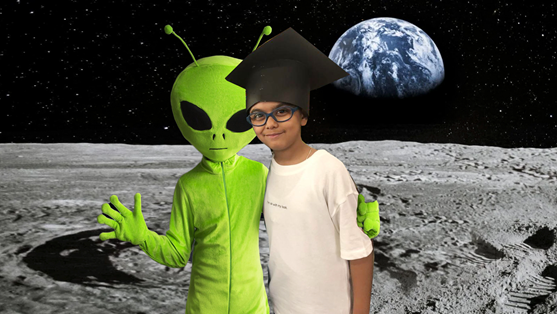
People have always been fascinated by space, from observing the Moon to sending rovers to Mars. This article describes a young learner’s encounter with “ETs” in Ahmedabad: not little green creatures, but meteoroids and other space-related discoveries.

Meteoroids are chunks of rock travelling through space. When they enter Earth's atmosphere they become meteors; those that survive the journey and land on the surface are called meteorites. The author visited the Physical Research Laboratory (PRL) during World Asteroid Day celebrations and explored more than ten laboratories.
Telescopes help scientists observe the Moon and celestial bodies. Long-exposure photographs can show star trails caused by Earth's rotation.
Scientists study lightning-like phenomena beyond Earth, including research into possible lightning on Venus.
Simulators help researchers recreate environmental conditions to test materials such as meteorites and moon rocks, supporting the design of space-exploration equipment.
Radiation-detection equipment helps researchers study radiation and conditions relevant to space science.
Exploring these laboratories shows how curiosity, observation and experiments can help us understand the universe and the possibility of life beyond Earth.
Editor’s note: The article was written by Kian Sarkar, a SciKnowTech student, following a visit to PRL.

Written by Sofiya Shahiwala Formally defined as a systematic enterprise that builds and organizes knowledge in the form of testable...

Young Science Writers' Program 2019 We, as humans, are throwing more than 8 million tons of plastics into the oceans...

Young Science Writers' Program 2019 “We are running the most dangerous experiment in history right now, which is to see...

Young Science Writers' Program 2019 Garbage can be generally defined as something which was produced by humans which proved to be...