
International Zebra Day
Written by Harshit Sharma



Written by Harshit Sharma
Dear, young explorers!
Have you ever wondered why zebras have those cool black and white stripes? Let’s embark on a fun journey to uncover the secrets behind these fascinating patterns that are found amidst nature and discover how they’re connected to DNA.
Imagine you’re drawing a zebra. You’d probably start with a horse-like shape and then add those distinctive black and white stripes, right? But have you ever thought about why zebras have these stripes in the first place?
Scientists have been curious about this for a long time. Some believe that the stripes help zebras stay cool under the hot sun, while others think they might confuse predators and act as camouflage or even keep pesky flies away. It’s like nature’s own puzzle!
DNA, or deoxyribonucleic acid, is like a set of instructions found in every living cell. It determines various traits, including the development of a zebra’s stripes.
Researchers have discovered that specific genes in a zebra’s DNA control the production of pigments, which are substances that give color to the skin and hair. The interaction of these genes leads to the distinctive black and white stripe patterns we see on zebras.
Inside the zebra’s DNA, there are specific instructions that determine the pattern of its stripes. Scientists have discovered that certain chemical reactions in the body create these patterns, each distinct from the other. These reactions decide where the black and white stripes will appear on the zebra’s body.
Interestingly, the same kind of chemical patterns that form zebra stripes also play a role in other natural designs, like the spots on leopards or the patterns on butterfly wings. It’s amazing how a simple set of instructions can lead to such diverse and beautiful designs in nature!
There are several hypotheses to explain why zebras have stripes:
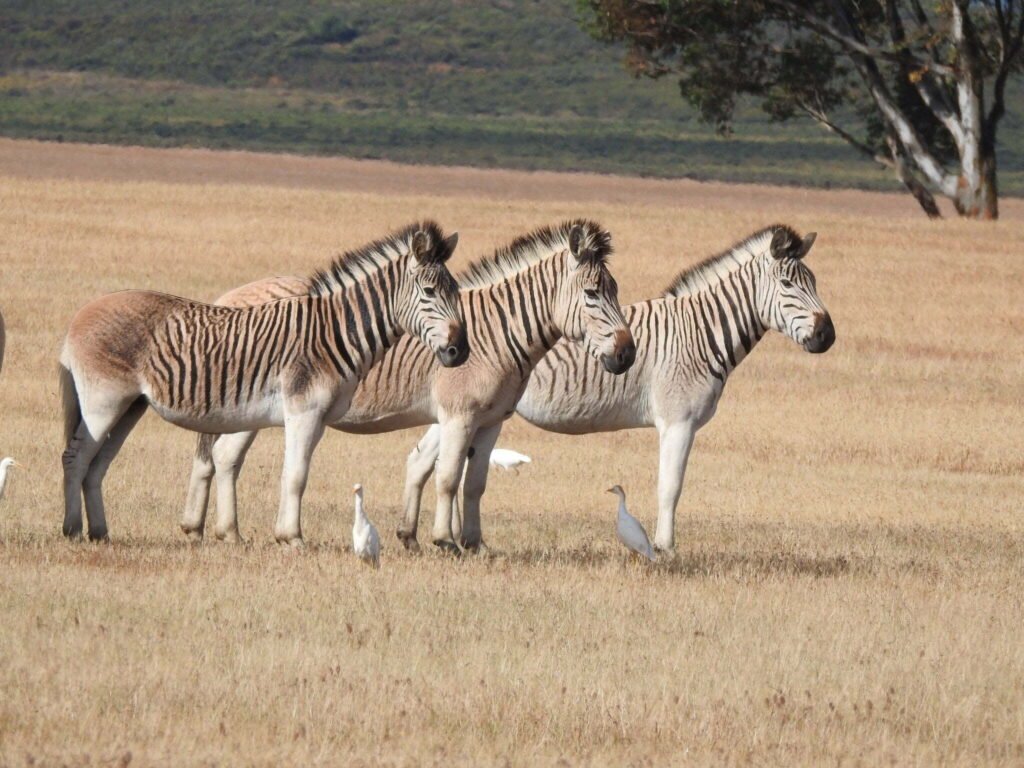
There used to be an animal called the quagga, which looked like a mix between a zebra and a horse. It had stripes only on the front part of its body, and the rest was plain. Sadly, the quagga went extinct a long time ago.
But guess what? Scientists are trying to bring it back by carefully breeding zebras that have fewer stripes, hoping to recreate the quagga’s unique look. It’s like trying to solve a big jigsaw puzzle using DNA!
Understanding how DNA creates patterns like stripes helps scientists learn more about genetics, which is the study of how traits are passed down from parents to their offspring. This knowledge can help in many ways, like conserving endangered species or even understanding human health better.
Nature is full of wonders, and the story of the zebra’s stripes is just one of them. The more we explore and ask questions, the more amazing stories we’ll uncover. So, keep your curiosity alive, and who knows what incredible discoveries you’ll make in the future!
Daysoftheyear.com. (n.d.). International Zebra Day. Retrieved January 29, 2025, from https://www.daysoftheyear.com/days/international-zebra-day/
Quagga Project. (n.d.). The Quagga Project: Breeding Back an Extinct Animal. Retrieved January 29, 2025, from https://www.quaggaproject.org/
Smithsonian Magazine. (2014, April 1). How the zebra got its stripes, according to science. Smithsonian Institution. Retrieved from https://www.smithsonianmag.com/smart-news/how-zebra-got-its-stripes-according-science-180950367/
University of California, Los Angeles. (2015, January 13). Why do zebras have stripes? UCLA biologists offer new evidence. UCLA Newsroom. Retrieved from https://newsroom.ucla.edu/releases/why-do-zebras-have-stripes
Caro, T., Izzo, A., Reiner, R. C., Walker, H., & Stankowich, T. (2014). The function of zebra stripes. Nature Communications, 5(3535). https://www.nature.com/articles/ncomms4535

Written by Sofiya Shahiwala Formally defined as a systematic enterprise that builds and organizes knowledge in the form of testable...

Young Science Writers' Program 2019 We, as humans, are throwing more than 8 million tons of plastics into the oceans...

Young Science Writers' Program 2019 “We are running the most dangerous experiment in history right now, which is to see...

Young Science Writers' Program 2019 Garbage can be generally defined as something which was produced by humans which proved to be...