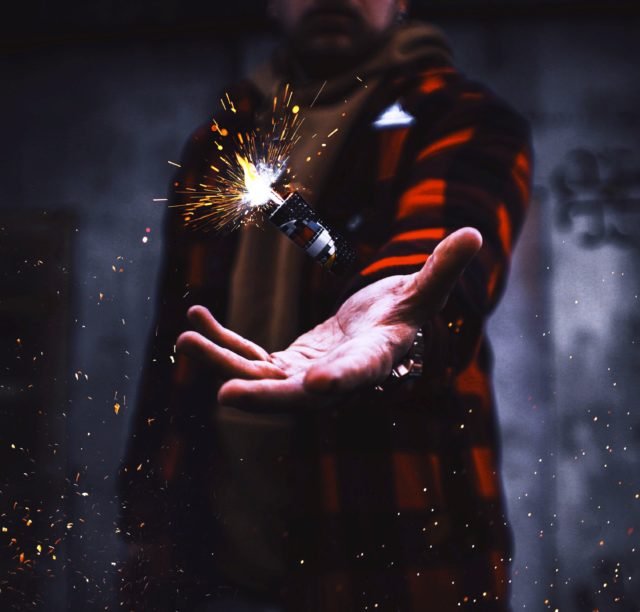
The Science Behind Crackers
Written by Harshit Sharma



Written by Harshit Sharma
With Diwali on at full swing, we all are tremendously excited about watching a sky overspread with lighting and colors. However, little do we know
about the creative chemistry behind our much so beloved fire-crackers.
The fundamental science behind Firework, also known as Pyrotechnics has come a long way since its invention. Dating back to as early as the Song Dynasty in China, local people popularly believed that fireworks were a source to expel possible evils (by the deafening noise) and bring good luck.
Moreover, it is traditionally believed that Fire-crackers were discovered by accident when a Chinese cook mixed Honey, Sulphur and Saltpetre (Potassium Nitrate).

These crackers were carefully lit by hand and exploded on the ground level. Today, technology has advanced so much that we come across crackers of various shapes, colors, and effects. They have the power to expand up to 75 feet and radiate over five minutes.
The core components of a firework prominently include Fuels, Oxidizers, color-producing salts, and a binder to support everything together. They emit varied colors depending upon how the elements react when heated. For example, Charcoal is typically used to produce gold color and titanium for white color.
When heat is applied to the fuel of the cracker (the gun powder), it burns fiercely using the oxygen. However, since the fuel is tightly packed, it naturally produces the characteristic sound/bang of a fire-cracker.
As a matter of fact, we all are aware of the great underlying dangers of these crackers. The firework industry is universally known for its accidents. The crackers are safe when kept in a cool and dry place, but there is inevitably a risk of it catching fire.
Did you know, the legendary singer Michael Jackson’s hair caught fire while he was working with pyrotechnics for a Pepsi Commercial?
To properly safeguard the citizens, many countries have banned the individual usage of Fireworks. Only community displays, with the official permission of the government, are allowed to take place. In India, the Supreme Court put a ban on firecrackers in Delhi due to the increasing pollution. The pyrotechnic industry faced an economic loss of over ₹1000 crores. Even after the prohibition, many violated the law and used crackers during Diwali.
Here, the youth must understand that only we can help ourselves. Be it Science, Be it any other field. The citizens must be genuinely more concerned about grave matters than the government.
– Sofiya Shahiwala


Written by Sofiya Shahiwala Formally defined as a systematic enterprise that builds and organizes knowledge in the form of testable...

Young Science Writers' Program 2019 We, as humans, are throwing more than 8 million tons of plastics into the oceans...

Young Science Writers' Program 2019 “We are running the most dangerous experiment in history right now, which is to see...

Young Science Writers' Program 2019 Garbage can be generally defined as something which was produced by humans which proved to be...