



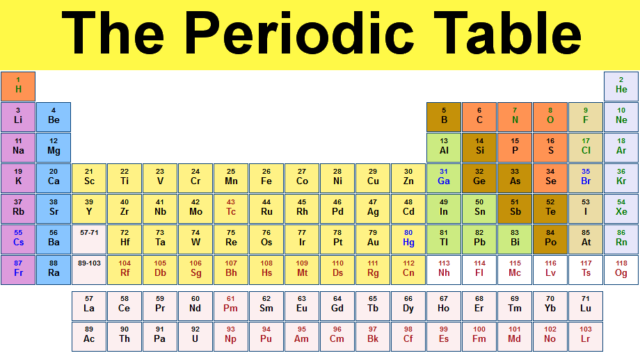
Hydrogen, Helium, Lithium… Magnesium? Or was that Beryllium? Also, where does it ever end? Don’t they have names belonging to scientists as well? Like, Einsteinium or something?
Well, if you’re also in the middle of learning the names of the elements of a table which goes on till eternity, I assure you one thing – You have stopped by the right place.
Once again, let’s combine fun and learning, and create intellect.
Here are a few facts on the Periodic Table which might make you gasp!
- Take a Modern Periodic Table and cut out the middle columns. Now, fold the chart along the middle of the Group Four (04). The groups that ‘kiss’ have complimentary electronic configuration and will most likely combine with each other. This is known as the Atomic Love.
- Digging up the history, we have not been using the same Periodic Table which was crafted by Mendeleev. The most significant change in the chart would be the change in the order of the arrangement.
Mendeleev’s Periodic Table was designed by keeping the order of increased atomic weight. However, the modern Periodic Table focuses on increasing atomic number. - The atoms having an atomic number higher than 94 do not exist naturally!
These can be made in the laboratory by bombarding different elements. - Uranium is considered to have the shortest half-life while Bismuth has the longest.
- The rarest occurring element in the world is Astatine. Its half-life is just 8.1 hours. Thus, even if you do find it, more than half of it might be gone when you return from school.
- The famous chemist Glenn Seaborg was the only person who could write his entire address in elements from the periodic table.
- There is no element in the entire periodic table with the letter J in it!
26 Letters of the alphabet and 118 Elements of the Periodic Table? What are the odds!?
After discovering 118 elements in the periodic table, now it has become much more difficult for scientists to manipulate and find new elements. Moreover, the chemists take years to find one single element, fusing and smashing different atoms together to get just the right proportion, leading to a new element. The chances, with the increasing size and number, for finding (naturally) or creating (laboratory) a new element/s are very slim. However, one can never predict the future!


